AzuKo

Design is meeting needs

We attended a ‘design quality’ conference for the built environment. One workshop, ‘Winning the hearts and minds’ was summarised as, ‘Engaging the community to obtain a YIMBY instead of a NIMBY (not in my back yard),’ or ‘How to assure you get your design through planning without local opposition’.

This suggests quality design is not a result of quality engagement, but rather, engagement is simply a tool to gain people’s favour (and that we already know what quality design is, so why would we need to learn from those who live and work there?)

What our project with Emmaus St Albans shows is that quality engagement right from the outset is vital for design that does what it’s supposed to do - meet users needs, hopes and dreams.

We began working with homelessness charity Emmaus UK in collaboration with Ryder and CRASH. We led a participatory design process to define the ‘big idea’ for expansion of their building in St Albans. This building is responsible for housing, training and employing 33 formerly homeless people.

Emmaus UK supports over 700 homeless men and women every year, known as companions. The social enterprise arm of Emmaus UK - their shops - recycles or reuses 3,302 tonnes of items. The shops are central to the charity’s success. They provide opportunities for companions to rehabilitate, learn and grow, while supporting the financial sustainability of the charity.

We gained insight into the experience and needs of those using the building - the companions, staff, leadership and trustees through co-design workshops, interviews, focus groups, participatory photography, and most importantly conversations over cups of tea.

A consensus was reached to expand the storage and shop floor space, something that came as a surprise to the Chief Executive, who believed the companions would have chosen to expand the leisure space.

Companion
Companions

Since the completion of the building, “profitability went up 23%”. The CEO, Tony Ferrier, believes the expanded space and storage has allowed staff to better look after and store items, creating an improved experience for them and for customers.

The St Albans location has added resiliency to the greater Emmaus Hertfordshire branches. One staff member shares,

It’s taken a bit of pressure off. We have another shop that isn’t doing quite as well. It still means that we’re keeping steady. [It’s] a safety net.

Our early conversations with companions revealed that there was a fundamental issue with loading furniture and other goods into the shop. There were between 7 and 10 tonnes of furniture going through the front door each year, which caused “havoc” one companion described.

It’s made a vast improvement on the shop. I could remember one time we were having to lug an item, trying to stack it in there and trying to lift [sofas, king sized beds and stuff like that] past customers without hitting them... trying to get it through that front door, which is not exactly the biggest.
Companion

Friction with customers before the extension led to arguments. This friction was aggravated by the physical and psychological state the companions may be in at any particular time. One companion shared, “a lot of people that come in here they suffer from anxiety, depression… not able to talk to people. When I first moved in here, I had really bad anxiety”.

The new space has gone a long way to address the range of needs for the range of users. As a result of the building “you’re not banging around so much, you’re not trying to dodge customers” and “we don’t have customers diving on us before the furniture’s even been put up”.

Since construction, companions and staff have noticed a range of positive outcomes. Aside from, “it has made life a lot easier” the expanded space has ultimately resulted in:

  • Increased safety in the management of stock coming into and out of the shop - greater ease of working

  • More opportunities for companions to work and grow

  • Fewer mistakes, particularly around merchandising - greater confidence working on the shop floor

  • Reduced friction between companions and customers

  • A greater sense of place and belonging in the building

  • More professional layout of goods

These outcomes are a direct result of brilliant collaboration between companions, staff and customers. The shop has improved financial sustainability for the charity, the shopping experience for customers, and physical and psychological security for companions.

To learn more visit the project page.


Author: N. Ardaiz

Learning through play

Our work with JAAGO Foundation to create a new playground, is more than simply designing a space for recreation. It’s an extension to the classroom. Many studies demonstrate the ways in which play supports children’s learning and development. Roleplay, for example, helps children to develop oral language skills, storytelling and vocabulary. As they pretend play, they are learning the semantics of language and developing their writing skills.

In Bangladesh, ‘jatra’ or theatre, is an important part of the culture that incorporates singing, dancing, roleplay and dramatic monologues. Jatra is often used to pass down stories about history and religion, and serves as a valuable tool to help children develop literacy skills.

At the beginning, there was no technology and no radio, at those times people in villages would organise a get together and bring other people to learn more about religion and history.
— Azit Roy, famous Jatra performer in northwest Bangladesh

We chatted with students from JAAGO school to hear more about the games they enjoy. 11-year old Utti* loves to play ‘kana machi’ (blind fly), an outdoor game where one team runs around a blindfolded player - the blind fly - whilst the others try to evade capture. Once the kana machi has successfully caught another player, the participants sing ‘kana machi bobo jake pabo taka cho’ (blind fly flying with bobo anyone I find I touch) and the captured player takes their place.

Playtime

Having dedicated outdoor space at school, for storytelling and games such as kana machi, supports students to build both academic and non-academic skills. It paves the way for children to be positive contributors to society.

Outdoor play offers something unique that either cannot be achieved, or is more difficult to achieve in indoor play.
— The SAGE Handbook of Outdoor Play and Learning, 2017

Play also has significant benefits for numerical development and there is a wealth of research that demonstrates how play provides children with a strong foundation for future mathematical understanding. Playing with basic equipment such as water and sand encourages logical mathematical rationale, scientific reasoning, and cognitive problem solving. While playing with building blocks strengthens children’s ability to categorise geometric shapes and compose larger shapes with smaller shapes.

Sadly, many children in Bangladesh don’t get the chance to play at school or at home, as academic studies and helping with the housework often take precedent, and many schools don’t have access to playgrounds. Play is not seen as a priority.

We understand the importance of play for children’s learning and development, and have designed JAAGO playspace with this in mind. A creative wall will provide a space for students to engage with shapes, and colours, and create music together - aiding sensory development and sequential understanding. A circular theatre will act as a stage for students to perform jatra, develop their creative writing skills and vocabulary. There will be spaces for reflection and areas for challenge, where students will need to negotiate their environment, building coordination and orientation skills.

I really enjoy listening to storytelling and I learn it from my parents and teacher. We sometimes do storytelling at school and I enjoy it. I like to tell stories about fairy tales.
— Student

Play is not a 'nice to have', it's a child's basic right that leads to significant educational progression. The new playground will support students on their educational journey as they continue into adulthood.

Read more about the project

Author: C. Taylor

(*name changed)

Empowering and investing in women

We’re so pleased to welcome Reena Agarwal to our board of Trustees. She brings a wealth of experience in international development and a passion for social justice. Reena reflects on her time in Bangladesh and previous work with women’s cooperatives…

I recently joined AzuKo as the International Development Trustee. I’m responsible for providing strategic advice in relation to our work delivered overseas. Over the last three months I’ve been humbled to learn more about AzuKo’s work with women, in particular the transfer of skills and knowledge to increase safety and wellbeing in their homes and communities.

More women live in poverty than men. Many have limited access to credit, healthcare and education and the impacts of that are further aggravated by global food and economic crises, as well as climate change.

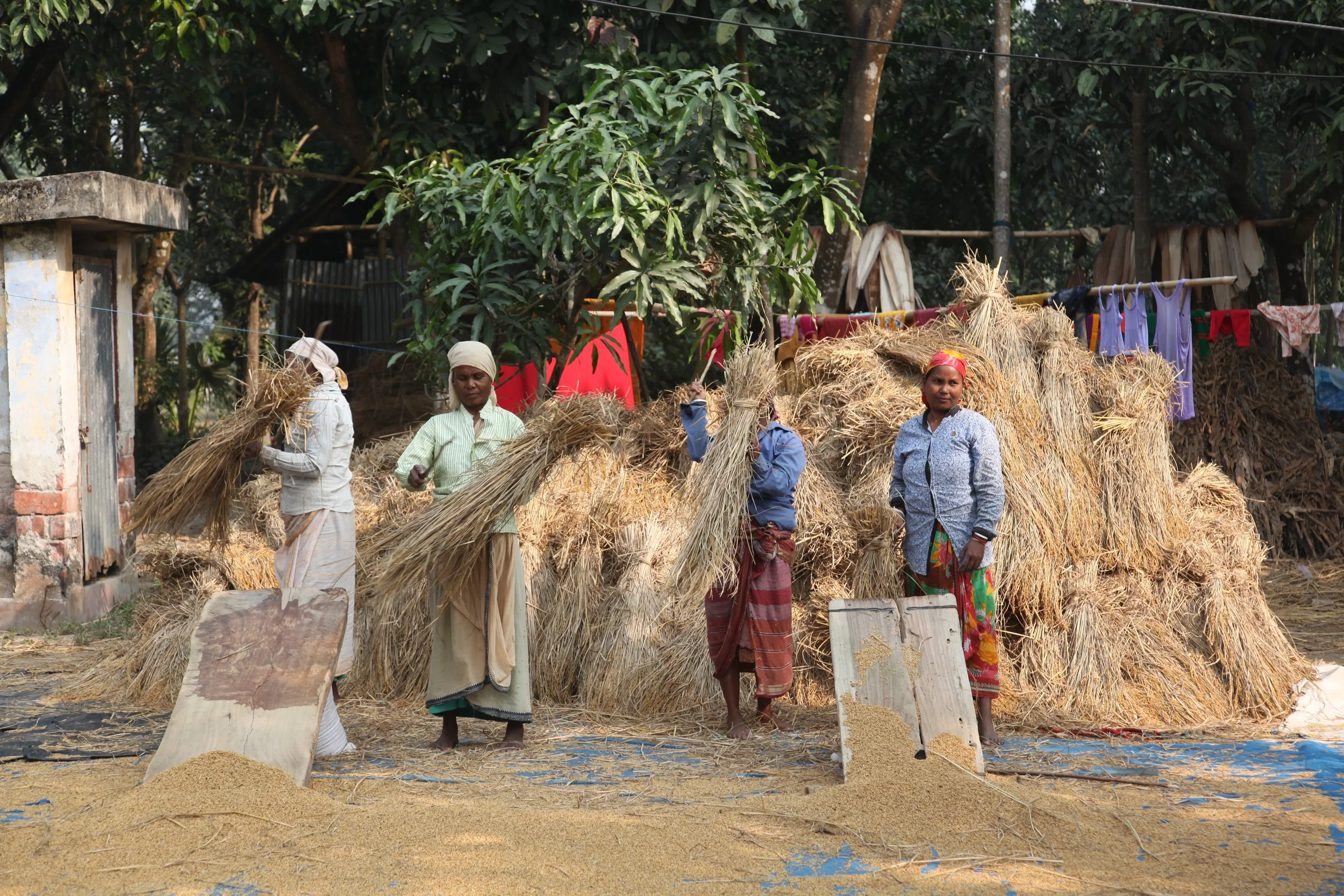
Hearing about AzuKo’s Heart of the home project in Dinajpur – empowering women to be design leaders – took me back to my time to Bangladesh eight years ago when I visited an all female cooperative in Rangpur. Cooperatives are enterprises controlled by and run for the benefit of their members, where profits are held to develop the business or are returned to the members, rather than benefiting third parties. They generate jobs which in turn provide income. This set up is very powerful as it provides financial independence to their members and empowers them to plan for and be in control of their future.

The cooperative in Rangpur was working with Oxfam in the Enterprise Development Programme with the aim of expanding their operations so they could own more of the dairy supply chain thus getting more of the value and in turn increased income.

Women and milk product
Milk urns

They lived in precarious conditions on chars – silt lakes which flood at certain times of the year. During these times they had to migrate to shelters with their cattle but despite this challenge they were certain that together they could make the project work. They told me that clarity, transparency and fairness were key. They wanted to make sure the weighing scales were accurate, that everyone was clear on their role and that all members were happy with the salary they received.

Finance book
I was blown away by their collective vision, their dedication and ability to grasp new skills. Each member had a voice around the table, the energy was contagious. It was no surprise to me that this group of women were successful in achieving their longterm plans in a fair and equitable way.

Empowering and investing in women – which AzuKo does so well – is crucial for the wellbeing of individuals, families and rural communities to prosper and lift themselves out of poverty. Rural women are key agents in the sustainable development process and are a catalyst for transformative economic, environmental and social change.

I’m very much looking forward to visiting the communities that AzuKo is working with to understand more about their environment, hear about their vision for the future and the opportunities they foresee.

Meet more of AzuKo’s team.

Author: R. Agarwal